Things to Do in Colombia: 12 Best Places and Experiences
The best things to do in Colombia are exploring the walled city of Cartagena, staying on a coffee farm in the Andes and walking among the wax palms of the Cocora Valley. Other favourites include Bogotá’s Gold Museum, the cable cars of Medellín and a boat day to the Rosario Islands, and the best places to visit in Colombia also include Tayrona’s beaches, colonial Villa de Leyva and the stone statues of San Agustín.
Colombia mixes the Caribbean coast, green coffee hills and cool mountain cities, and short domestic flights link them. The list below is grouped by region. Each entry says how it fits a trip and which of our routes covers it; places that are not on our set routes are marked as additions we can build into a private itinerary. For the wider picture, start with our Colombia travel guide.
12 things to do in Colombia at a glance
| Place or experience | Region | Good to know |
|---|---|---|
| Cartagena’s walled city | Caribbean coast | Hot all year; explore in the morning and late afternoon |
| Rosario Islands | Caribbean coast | By boat from Cartagena; a day trip or a night |
| Bogotá | Eastern Andes | Around 2,600 m; take the first day gently |
| Zipaquirá Salt Cathedral | Near Bogotá | An easy half-day or day trip from the capital |
| A coffee farm | Coffee Region | Stay on a farm or visit for a tour |
| Cocora Valley | Coffee Region | Walks among very tall wax palms |
| Salento and Filandia | Coffee Region | Small, colourful mountain towns |
| Medellín | Central Andes | Cable cars, museums and a mild climate |
| Guatapé and El Peñol | Near Medellín | A long staircase up a granite rock |
| Tayrona and Santa Marta | Caribbean coast | Forest and beaches; the park closes at times |
| Villa de Leyva | Eastern Andes | Colonial town a few hours from Bogotá |
| San Agustín or the Tatacoa Desert | Southern Andes | Ancient statues or a dry, eroded landscape |
The Caribbean coast
1. Cartagena’s walled city
Cartagena is where many Colombia trips end, and with good reason. Its walled old town, with its port and fortifications, is a UNESCO World Heritage Site: cobbled streets, balconies covered in bougainvillea, shady plazas and colonial churches. Outside the walls, the San Felipe fortress guards the approach to the city, and the Getsemaní neighbourhood has street art, small restaurants and a lively evening feel.
The heat is strongest around midday, so a guided walk works best early, with a slow lunch and a siesta before the evening. Our 4-day Cartagena Short Break covers the walled city, San Felipe and Getsemaní, and it also works as an add-on to a longer route.
2. The Rosario Islands
South-west of Cartagena, the Rosario Islands sit within a protected marine park, with clear water, coral and small beaches. A boat takes you out for a day of swimming and snorkelling, or you can stay a night on the islands and enjoy them after the day visitors leave.
The Cartagena Short Break includes a night on the islands, while our 10-day Colombia for Families trip includes an island day from Cartagena. Seas are usually calmest in the drier months, roughly December to April.
3. Tayrona National Park and Santa Marta
Further east along the coast, Tayrona National Natural Park combines forested hills with beaches and coves near Santa Marta, with the Sierra Nevada de Santa Marta rising steeply behind. Paths lead through the forest to the beaches, and some stretches of sea are too rough for swimming, so local advice matters.
Tayrona is not on our set routes, but it makes a good addition to a private trip of two or three nights after Cartagena. The park closes periodically for environmental and cultural reasons, linked to the Indigenous communities of the Sierra Nevada, so we check its status when we plan your dates.
Bogotá and the eastern Andes
4. Bogotá: La Candelaria, the Gold Museum and Monserrate
The capital sits at around 2,600 metres, so days are mild and evenings call for a jacket. Most visits begin in La Candelaria, the historic centre, with its colonial houses, churches and street art. Close by, the Gold Museum holds a remarkable collection of pre-Hispanic goldwork, and many travellers rate it as a highlight of the city.
A cable car or funicular climbs Monserrate, the mountain above the city, for wide views over Bogotá. Our 12-day Colombia Highlights trip spends a full day on La Candelaria, the Gold Museum and Monserrate. Because of the altitude, take the first day gently; our guide to altitude in the Andes explains how to prepare.
5. The Zipaquirá Salt Cathedral
North of Bogotá, the town of Zipaquirá has an underground church carved inside a salt mine. You walk down through tunnels lined with the Stations of the Cross to a large, softly lit nave deep below ground. It is an unusual sight and an easy outing from the capital.
Zipaquirá is not part of our set trips, but we can add it as a half-day or full-day excursion with an extra night in Bogotá.
6. Villa de Leyva
A few hours’ drive from Bogotá, Villa de Leyva is a well-preserved colonial town of whitewashed houses and cobbled streets, set around a very large main square. The countryside around it is dry and open, with fossils, vineyards and small museums to explore.
Villa de Leyva is a possible addition rather than a stop on our set routes. Two nights there, after Bogotá, give a quieter contrast to the city.
The Coffee Region
7. A coffee farm visit or stay
The Coffee Cultural Landscape, listed by UNESCO, covers green hills of coffee bushes, bamboo and small farms in the central Andes. On a farm visit you follow coffee from the bush to the cup: picking, drying, roasting and tasting. Staying on a farm adds birdsong at dawn and quiet evenings.
Our three longer Colombia trips all include the Coffee Region. Colombia for Families is built around a farm stay, with a full day on how coffee is grown and made, while Colombia Highlights includes a visit to a working farm.
8. The Cocora Valley and its wax palms
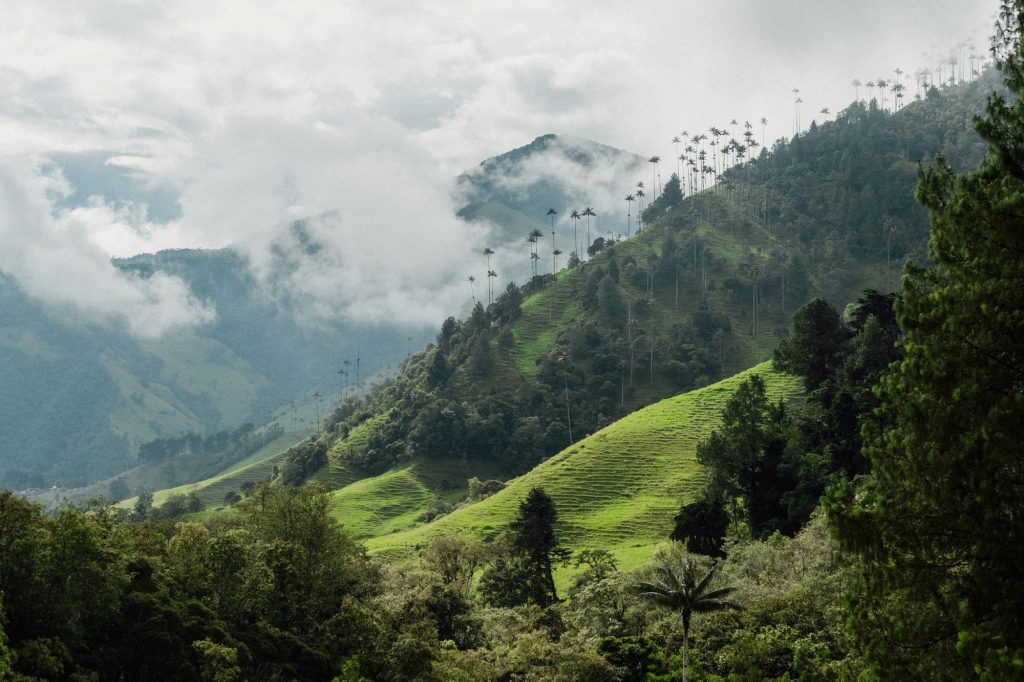
Near Salento, the Cocora Valley is home to the Quindío wax palm, Colombia’s national tree and one of the tallest palms in the world. The slim trunks rise high above green pastures and cloud forest, and walks range from a short stroll to a longer loop through the forest.
All three of our longer Colombia trips include a day in the Cocora Valley and Salento. Paths can be muddy after rain, so good shoes help.
9. Salento and Filandia
Salento is a small mountain town of brightly painted houses and balconies, with craft shops and cafés along its main street and a viewpoint over the valley. Filandia, nearby, is similar in style and usually quieter.
Our 18-day Colombia and Ecuador trip adds a day in Filandia and the countryside after the Cocora Valley, before flying on to Quito and the Galápagos.
Medellín and Antioquia
10. Medellín: cable cars and Comuna 13
Medellín lies in the Aburrá Valley and has a mild climate all year. Its metro connects with cable cars that climb the hillside neighbourhoods and give wide views across the city. Museums, squares and parks fill the centre.
Comuna 13, a hillside district on the west side of the city, is now known for its outdoor escalators, murals and local guides who explain how the neighbourhood has changed. Colombia Highlights spends a day on the city and Comuna 13 with a guide. For practical advice on cities, see our guide to whether Colombia is safe.
11. Guatapé and El Peñol
About two hours from Medellín, the granite rock of El Peñol rises above a maze of lakes and islands. A long staircase, several hundred steps, leads to the top and a wide view of the water. Below, the town of Guatapé is known for the colourful painted panels along the lower part of its houses.
Colombia Highlights includes a day trip to Guatapé and El Peñol from Medellín.
Further afield
12. San Agustín or the Tatacoa Desert
In the south, the archaeological park of San Agustín, a UNESCO site, preserves large stone statues carved by a culture that lived there long before the Spanish arrived. Not far away, the Tatacoa Desert is a dry area of red and grey eroded gullies, known for clear night skies and stargazing.
Both are remote and take time to reach, so they suit a second visit or a longer private trip. Neither is on our set routes; we can plan them as an extension, usually with at least two or three nights.
How to combine them
Most first trips link Bogotá, the Coffee Region and Cartagena, with Medellín added if you have more time. Starting in the mountains and finishing on the Caribbean coast gives you a relaxed end to the trip. A few common shapes:
- About 4 days: Cartagena and a night on the Rosario Islands, as on our Cartagena Short Break.
- About 10 days: Bogotá, a coffee farm stay and Cartagena, as on Colombia for Families.
- About 12 days: Bogotá, the Coffee Region, Medellín with Guatapé, and Cartagena, as on Colombia Highlights.
- About 18 days: Cartagena and coffee country, then Quito and the Galápagos, as on Colombia and Ecuador.
Zipaquirá, Villa de Leyva, Tayrona or San Agustín can be added to any of these. December to March is usually the driest time across most of the country; see the best time to visit Colombia, and our Colombia itinerary guide for day-by-day plans.
On a private trip, we fly you between regions and arrange a driver for the shorter hops, so long road days are kept to a minimum. A local guide joins you in each city and at the main sites, and we book boats, excursions and timed entries for you, confirming current arrangements when we book.
Frequently asked questions
Colombia is known for its coffee, the colonial walled city of Cartagena, its Caribbean beaches and its lively Andean cities. It is also one of the richest countries in the world for birdlife. Our Colombia guide gives an overview of each region.
Bogotá, the Coffee Region, Medellín and Cartagena make the classic first route. Each leg is a short domestic flight. Our 12-day Colombia Highlights trip follows this route.
About 10 days covers Bogotá, the Coffee Region and Cartagena at an easy pace, and 12 days lets you add Medellín. With a week or less, choose two regions rather than rushing. Our Colombia itinerary guide sets out several options.
Yes. Its walled old town is a UNESCO World Heritage Site, and the Rosario Islands are an easy boat trip away. Three or four days is a good length, as on our 4-day Cartagena Short Break.
Yes, usually from Santa Marta, as an addition after Cartagena. The park closes periodically for environmental and cultural reasons, so we check its status when planning. The drier months, roughly December to April, are usually best for the beaches.
The main travel regions, including Bogotá, Medellín, the Coffee Region and Cartagena, welcome many visitors each year, and sensible precautions go a long way. Conditions can change, so check your government’s travel advice before you go. Our guide to whether Colombia is safe has practical tips.


